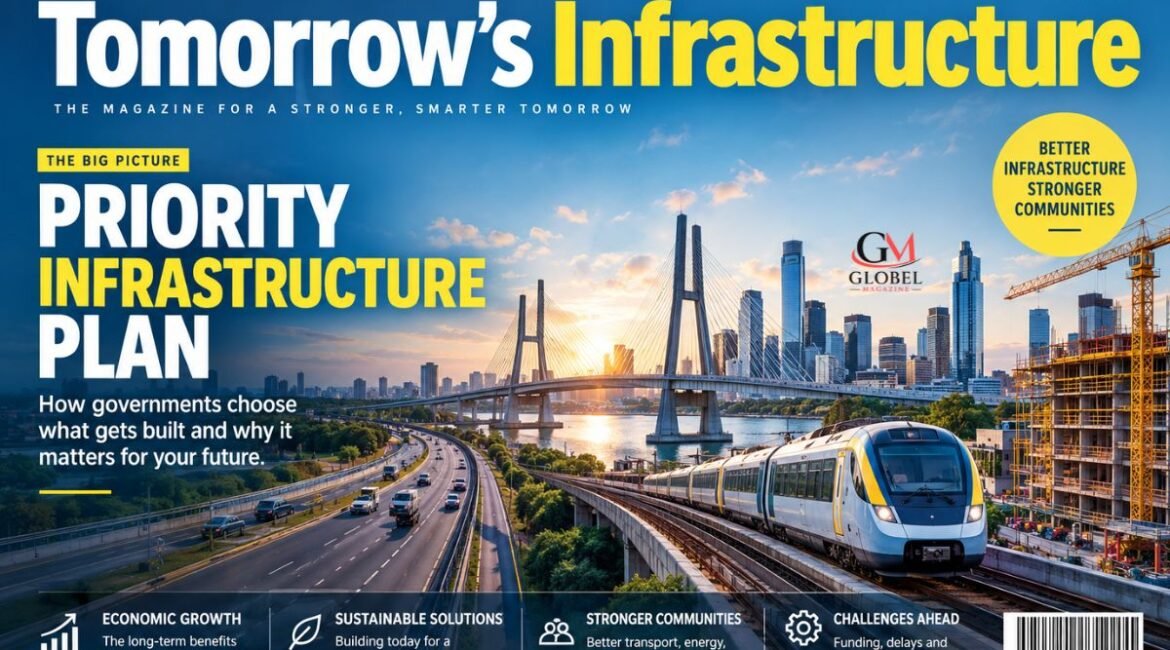
What Is a Priority Infrastructure Plan?
A priority infrastructure plan is a strategic framework for deciding which infrastructure projects should receive attention, funding, and resources first.
Governments cannot build every road, railway, power system, water network, or public facility at the same time. A priority-based approach helps decision-makers focus on projects that can deliver the greatest public and economic value.
The term can describe different planning systems depending on the country. It is not automatically the name of one specific government program.
For example, Australia publishes an official Infrastructure Priority List to advise the federal government on nationally significant projects. In the United States, a 2025 policy proposal called the “Priority List” suggested giving special treatment to a limited number of major infrastructure projects.
Why Infrastructure Needs Clear Priorities
Infrastructure decisions involve enormous amounts of money and long construction timelines.
A poorly selected project can tie up public funds for years. A well-chosen project can improve transportation, support businesses, strengthen communities, and increase economic productivity.
A priority infrastructure plan creates a process for comparing competing needs.
Instead of asking only what can be built, planners can ask what should be built first and why.
The main goals usually include:
- Improving public services
- Supporting economic growth
- Reducing infrastructure gaps
- Increasing regional connectivity
- Managing limited budgets
- Preparing for population growth
- Improving resilience and sustainability
This approach also makes government investment easier to explain. Citizens, businesses, and investors can see why certain projects have been placed ahead of others.
What Goes Into a Priority Infrastructure Plan?
A strong plan is more than a list of construction projects.
It normally connects long-term development goals with project selection, funding, timelines, risk management, and expected results.
1. Project Identification
The first step is identifying infrastructure needs.
These may come from population growth, aging assets, transport congestion, energy demand, water shortages, housing expansion, or changing economic conditions.
Planners then develop potential projects to address those needs.
2. Project Assessment
Not every proposed project deserves the same level of priority.
Governments can assess projects using factors such as economic benefits, costs, demand, environmental effects, readiness, and community impact.
The assessment helps separate urgent needs from projects that can reasonably wait.
3. Funding Strategy
Infrastructure requires reliable financing.
A plan can identify potential sources such as government budgets, municipal finance, development institutions, private investment, or public-private partnerships.
Funding arrangements are especially important for large projects that may take several years to complete.
4. Delivery Timeline
A priority infrastructure plan should show when projects are expected to move forward.
Projects may be divided into short-term, medium-term, and long-term pipelines.
Australia’s current Infrastructure Priority List, for example, distinguishes investment-ready proposals from projects in the two-to-four-year and five-to-ten-year pipelines.
Which Sectors Are Usually Prioritized?
Infrastructure priorities differ between countries and regions.
However, several sectors appear repeatedly in major infrastructure planning systems.
Transportation
Transportation is often one of the biggest areas of infrastructure investment.
Projects can include:
- Highways and bridges
- Railways
- Public transit
- Airports
- Ports
- Freight corridors
- Urban transport systems
Better transportation can reduce travel times and improve the movement of goods.
It can also strengthen connections between workers, businesses, cities, and markets.
Energy Infrastructure
Reliable energy is essential for households and businesses.
Priority projects may include electricity generation, transmission lines, distribution networks, renewable energy facilities, and energy storage.
As economies become more dependent on electricity and digital technology, reliable power infrastructure becomes even more important.
Water and Wastewater
Water systems are another core infrastructure priority.
Investment may cover drinking-water supplies, wastewater treatment, drainage, irrigation, flood management, and water-security projects.
These systems can become increasingly important as cities grow or climate risks increase.
Digital Infrastructure
Modern infrastructure planning increasingly includes digital connectivity.
Broadband networks, communications systems, data infrastructure, and other digital assets support businesses, government services, education, and remote work.
Digital infrastructure can therefore influence economic competitiveness just as physical transportation networks do.
Social Infrastructure
Infrastructure planning can also include facilities that directly support communities.
Examples include schools, hospitals, community facilities, and other public assets.
The exact scope varies by country and government planning system.
How Are Infrastructure Projects Ranked?
Ranking projects is one of the most important parts of the process.
A government may have dozens or hundreds of proposals competing for limited resources. A consistent assessment method can make those decisions more transparent.
Economic Value
A major consideration is the project’s potential economic impact.
Planners may examine whether a project can improve productivity, reduce logistics costs, create jobs, support trade, or unlock development.
Economic benefits are usually considered alongside the project’s total cost.
Public Need
A project can also receive priority because it addresses an urgent community need.
For example, a region experiencing severe congestion or water shortages may require investment sooner than an area with adequate existing capacity.
Project Readiness
A project that already has strong planning, approvals, land arrangements, and a business case may be easier to deliver than an idea still at an early stage.
This does not necessarily mean ready projects are always more important.
It means readiness can affect when a project can realistically move into construction.
Environmental and Social Impact
Modern infrastructure planning also considers environmental and social consequences.
Governments may assess issues such as emissions, land use, community impacts, biodiversity, and climate resilience.
The goal is to ensure that infrastructure delivers long-term benefits without creating unnecessary costs elsewhere.
The U.S. Priority List Proposal
The phrase priority infrastructure plan has gained attention in part because of a U.S. policy proposal known as the Priority List.
David Schleicher, a Yale Law School professor, proposed the idea in a 2025 paper produced through a joint Brookings-AEI project.
The proposal is important to understand correctly because it is not an enacted federal program.
Schleicher’s idea was to create a short list of nationally important and publicly supported infrastructure projects. Congress would consider the projects as a package rather than handling each project separately.
The proposal focuses heavily on transportation infrastructure.
Potential projects could include major bridges, rail systems, large transit projects, and other nationally significant developments.
Projects selected for the proposed list could receive additional federal planning expertise and preferential financing.
The proposal also discusses changing some regulatory requirements for selected projects to reduce delays and construction costs.
This makes the concept different from a conventional infrastructure wish list.
It is designed as a policy mechanism for getting a small number of major projects built more efficiently.
Australia’s Infrastructure Priority List
Australia provides a useful example of a formal infrastructure prioritization system.
Infrastructure Australia describes its Infrastructure Priority List as independent, evidence-based advice to the Australian Government on nationally significant proposals that should be considered for investment over the next decade.
The 2026 list includes priorities covering areas such as:
- High-productivity freight networks
- Ports and freight connectivity
- Transport for growing cities
- Water security
- Clean energy infrastructure
Infrastructure Australia reported 68 proposals in its 2026 list. The proposals are intended to support productivity, liveability, and sustainability.
This example shows why prioritization matters.
Governments may face more infrastructure proposals than they can fund or deliver simultaneously. A structured pipeline helps determine which investments should move forward first.
How a Priority Infrastructure Plan Can Support Economic Growth
Infrastructure affects the economy in several ways.
New transport links can reduce travel and freight times. Reliable electricity can support industrial activity. Better water systems can enable housing and commercial development.
Construction itself can also generate economic activity.
Over the longer term, the bigger benefit can come from the infrastructure’s ability to improve productivity and access to markets.
Potential economic benefits include:
- Lower transportation costs
- Better supply-chain performance
- Improved access to employment
- Increased business investment
- Stronger regional connectivity
- Support for housing and urban growth
The benefits depend heavily on project quality.
Simply spending more money on infrastructure does not guarantee better economic results.
Challenges Facing Infrastructure Priorities
Creating a priority list does not eliminate the difficulties of infrastructure delivery.
Projects can still face rising costs, approval delays, land issues, labor shortages, financing problems, and technical challenges.
Funding Pressure
Infrastructure projects can require very large investments.
Governments must balance infrastructure spending against healthcare, education, public safety, and other priorities.
A project can therefore be economically valuable but still difficult to finance.
Delays and Cost Overruns
Large infrastructure projects are often complex.
Changes in design, material prices, regulations, labor conditions, or construction conditions can increase costs.
Strong project management is essential from planning through completion.
Political Pressure
Infrastructure decisions can also become politically sensitive.
Local communities may support one project while regional or national planners prioritize another.
A transparent assessment framework can help governments explain their choices.
Environmental Concerns
Major construction can affect land, ecosystems, communities, and emissions.
Infrastructure planners increasingly need to consider resilience and environmental performance from the beginning rather than treating them as secondary issues.
The Future of Infrastructure Prioritization
Infrastructure planning is becoming more data-driven.
Governments can use population forecasts, traffic data, economic models, climate information, and digital monitoring systems to understand where investment is most needed.
Technology can also improve infrastructure after construction.
Sensors, artificial intelligence, connected transport systems, and predictive maintenance can help governments monitor assets and identify problems earlier.
Climate resilience will also matter more
Extreme weather can damage roads, bridges, power networks, and water systems.
Future priority plans are therefore likely to give greater attention to infrastructure that can withstand floods, heat, storms, drought, and other risks.
Public-private partnerships may remain important
Governments may also continue using partnerships with private investors for projects that require substantial capital.
However, financing should not replace careful project selection.
A privately financed project still needs a strong business case and clear public value.
What Makes a Good Priority Infrastructure Plan?
A successful plan should be realistic, transparent, and flexible.
It should explain not only which projects are important but also why they are important.
The strongest plans generally combine:
- Clear objectives
- Reliable data
- Transparent selection criteria
- Realistic funding assumptions
- Defined project timelines
- Strong accountability
- Environmental and social safeguards
- Regular review and updating
Infrastructure needs can change quickly.
Population growth, technology, economic conditions, and climate risks can all alter the priorities of a region.
For that reason, infrastructure planning should not be treated as a document that never changes.
Read More: auto account maker
Conclusion
A priority infrastructure plan provides a practical way to decide which infrastructure investments should move forward first. It connects limited public resources with the projects that can deliver meaningful economic and social benefits.
The concept can take different forms around the world. Australia’s Infrastructure Priority List is an established advisory system, while the U.S. Priority List is a policy proposal focused on improving the delivery of major infrastructure projects.
As cities grow and infrastructure demands become more complex, prioritization will become increasingly important. The strongest plans will combine economic value, public need, sustainability, resilience, and realistic project delivery.
Frequently Asked Questions
What is a priority infrastructure plan?
It is a framework used to identify and rank infrastructure projects according to factors such as public need, economic value, cost, readiness, and long-term benefits.
Is the Priority Infrastructure Plan a U.S. government program?
No. There is no U.S. federal program officially named the “Priority Infrastructure Plan.” The related U.S. concept is David Schleicher’s proposed “Priority List.”
What projects can be included?
Projects may involve transportation, energy, water, telecommunications, digital infrastructure, and social infrastructure.
How are projects prioritized?
Governments can consider economic impact, public demand, strategic importance, project readiness, cost, environmental effects, and long-term resilience.
Why is infrastructure prioritization important?
Governments have limited budgets and delivery capacity. Prioritization helps direct resources toward projects that can provide the greatest public value.
Does being on an infrastructure priority list guarantee funding?
Not necessarily. In Australia’s system, inclusion on the Infrastructure Priority List is advice for government investment decisions and does not itself guarantee funding.