Introduction
True agency for hotel means deploying AI systems that can actually take action — booking rooms, resolving guest complaints, adjusting pricing — rather than just answering questions or following rigid scripts. Most “AI” tools in hospitality today are glorified chatbots: they can tell a guest what time checkout is, but they can’t actually rebook a reservation or issue a refund without a human stepping in. True agency changes that equation. It gives AI systems the authority, context, and judgment to complete tasks independently, which means faster guest resolutions, fewer dropped requests, and staff who get to focus on the moments that actually need a human touch.
Key Takeaways
- True agency means action, not just information. An AI system with genuine agency can complete a task (rebooking, refunding, upgrading) rather than simply explaining what a guest should do next.
- Most hotel chatbots lack real agency. They’re built to answer FAQs, not make decisions or execute transactions on a guest’s behalf.
- Agentic AI requires three things: access, authority, and context. Without all three, an AI tool is just a glorified search bar.
- Hotels benefit from faster resolution times, 24/7 coverage, and staff freed up for high-touch service.
- There are real limitations. Agentic AI works best for well-defined, rules-based tasks — not nuanced guest relations or sensitive complaints.
What’s the difference between a hotel chatbot and a true AI agent?
A hotel chatbot answers questions. A true AI agent completes tasks. That’s the core distinction, and it’s one that gets blurred constantly in marketing copy across the hospitality tech space.
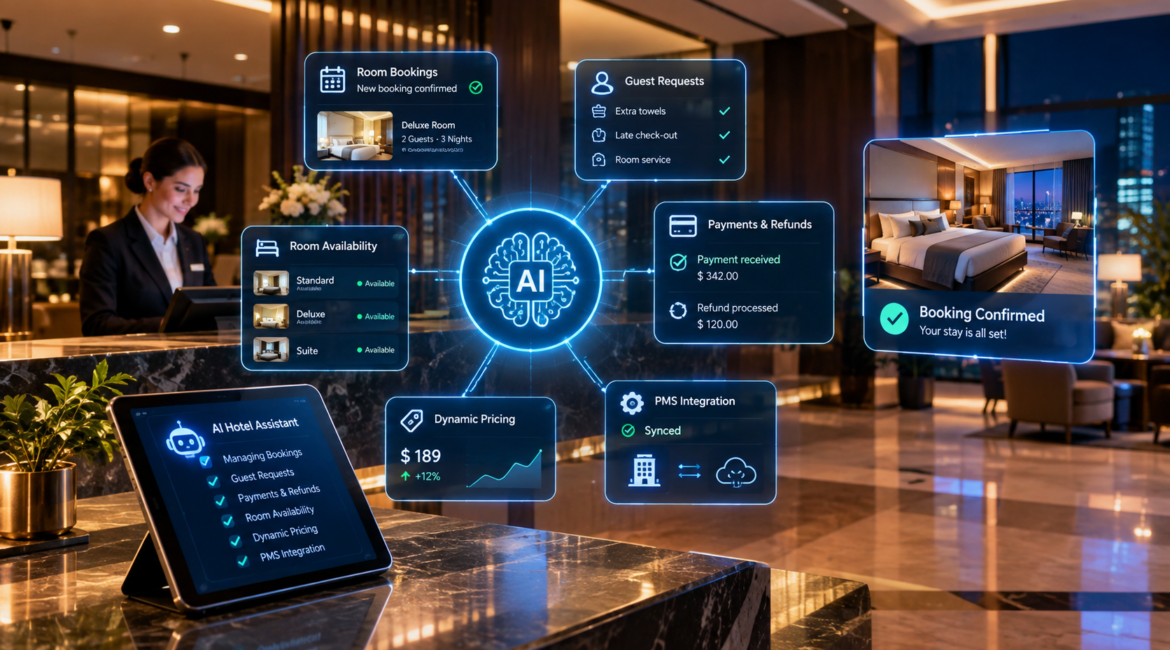
Say a guest messages your front desk chat widget at 11 p.m. asking to extend their stay by one night. A standard chatbot will tell them the hotel’s policy on extensions, maybe share a phone number, and call it done. A true AI agent checks room availability in real time, confirms the rate, charges the card on file, updates the property management system (PMS), and sends a confirmation — all without waking up a night auditor.
The difference comes down to whether the system can act within your actual business systems, or whether it’s limited to conversation. Agency implies consequence. If an AI tool can’t change a record, process a payment, or trigger a downstream action, it isn’t an agent. It’s an information desk with better grammar.
Why does True Agency for Hotel industry specifically?
Hospitality is an around-the-clock, high-volume, low-margin-for-error business, which makes it an unusually good fit for agentic AI — and an unusually risky one if that agency isn’t built correctly.
Three industry-specific pressures make this matter:
- Guest expectations have shifted. Travelers increasingly expect instant resolution, not a promise of a callback. A 2024 Zendesk CX Trends report found that most consumers expect a response within minutes when contacting a business digitally, a bar legacy hotel systems struggle to meet during overnight or peak-season hours.
- Staffing shortages persist. The American Hotel & Lodging Association has repeatedly flagged staffing as one of the industry’s top operational challenges, meaning fewer humans are available to handle the routine requests that eat up front-desk time.
- Margins are thin. Every minute a staff member spends manually processing a late checkout request or rebooking a reservation is a minute not spent on service that actually requires a human — upselling, resolving complaints, or building loyalty.
For a hotel, true agency isn’t a novelty feature. It’s a way to close the gap between what guests expect and what a lean staff can realistically deliver.
What does a hotel need for AI to have true agency?
Three things have to be in place before an AI system can act with real agency: system access, decision-making authority, and contextual awareness.
System access
The AI needs a direct, secure connection to the hotel’s core systems — the PMS, the point-of-sale system, the booking engine, and payment processor. Without that integration, an AI tool can describe actions but never actually perform them.
Decision-making authority
Someone has to define what the AI is allowed to decide on its own versus what requires a human sign-off. A well-scoped agent might be authorized to process refunds under $100, rebook standard rooms, or apply loyalty discounts automatically — while escalating anything involving a safety complaint or a VIP guest to a staff member.
Contextual awareness
A true agent needs access to relevant guest history — past stays, loyalty tier, prior complaints — so its actions are informed, not generic. An agent that doesn’t know a guest already complained twice this stay is going to make the problem worse, not better.
When all three are present, the AI stops being reactive and starts being genuinely useful: resolving issues the moment they arise, not days later in a follow-up email.
What are the benefits of giving hotel AI true agency?
Hotels that implement AI with real decision-making power see measurable gains in speed, consistency, and staff capacity.
- Faster resolution times. Guests don’t wait for a callback or a shift change to get an answer — tasks that used to take hours get handled in minutes.
- 24/7 coverage without added headcount. Agentic AI doesn’t need a night shift differential. It handles late-night requests with the same capability it has at noon.
- Consistency across interactions. A well-configured agent applies policy the same way every time, reducing the variability that comes from different staff members handling the same request differently.
- Freed-up staff time for high-value service. When routine tasks are automated, front-desk and guest-services staff can focus on the interactions that genuinely benefit from a human — a guest celebrating an anniversary, a complaint that needs empathy, a local recommendation that needs personality.
What are the limitations of agentic AI in hotels?
True agency isn’t a cure-all, and hotels that treat it as one risk damaging the guest experience rather than improving it.
Agentic AI performs best on well-defined, rules-based tasks: rebooking, refunds within policy limits, room upgrades based on loyalty tier, and FAQ-style requests. It performs worst on anything requiring judgment calls, emotional intelligence, or exceptions to policy. A guest who’s upset about a noise complaint on their honeymoon doesn’t need a perfectly executed refund — they need to feel heard, and that’s still a distinctly human skill.
There’s also a trust consideration. Giving an AI system the authority to spend money, move reservations, or alter guest records requires careful guardrails. A hotel should start with low-risk, high-frequency tasks (late checkout requests, simple rebookings) before expanding an agent’s authority into higher-stakes territory.
Choose agentic AI for repetitive, rules-based operational tasks. Choose human staff for anything involving emotional nuance, high-value guests, or policy exceptions — that’s where the agency should remain firmly human.
Start Small, Build Trust, Then Expand
True agency for hotel AI isn’t about replacing the people who make hospitality feel personal. It’s about making sure the routine stuff — the rebookings, the refunds, the 2 a.m. requests — gets handled instantly, so your staff can spend their energy where it actually counts. Start with one well-defined task, give the AI clear boundaries and real system access, and measure the results before expanding its authority. That’s how you build an AI system guests can actually rely on, instead of one that just sounds helpful.
Frequently Asked Questions
Is AI “agency” the same as AI “automation”?
Not quite. Automation typically follows a fixed, predefined sequence of steps. Agency implies the AI can assess a situation, make a decision within defined boundaries, and choose the appropriate action — closer to delegation than to a simple script.
How much does it cost a hotel to implement true agentic AI?
Costs vary widely depending on the complexity of existing systems and how many integrations are needed. Hotels with modern, API-friendly PMS platforms typically see lower implementation costs than those running legacy, closed systems that require custom integration work.
Can agentic AI replace front-desk staff entirely?
No. Agentic AI is best suited to repetitive, well-defined tasks. Hotels that have implemented it successfully use it to offload routine work, not to replace the human judgment and warmth that defines quality hospitality.
What’s the biggest risk of giving AI too much agency too quickly?
Granting broad authority before the system has proven itself on simple tasks. Hotels that scale agency gradually — starting with low-risk, high-frequency requests — tend to see better outcomes than those that hand over complex decision-making from day one.
Do guests actually want to interact with an AI agent instead of a person?
It depends on the task. Guests generally prefer speed for routine requests (checkout times, Wi-Fi passwords, simple rebookings) and prefer a human for anything emotionally charged or complex, like complaints or special requests.